Push-up
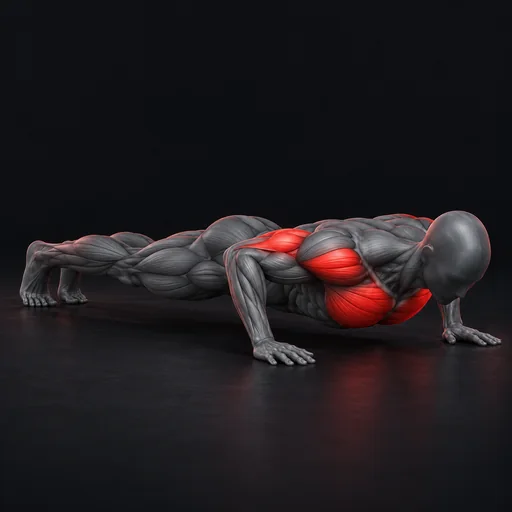
Push-up is a bodyweight exercise - closed-chain press exercise involving Pectoralis major, Triceps brachii. Use these steps to learn the movement and work with your coach to choose a suitable level.
Last updated: · DynPerformance
- Primary muscles
- Pectoralis major, Triceps brachii
- Secondary muscles
- Anterior deltoid, Serratus anterior, Rectus abdominis, Gluteus maximus
- Exercise type
- Bodyweight exercise - closed-chain press
Exercise technique
- Hand placement
Place your palms slightly wider than your shoulders and spread the bases of your fingers against the floor.
- Plank line
Extend onto your toes and form a straight line from head to heels.
- Torso tension
Engage your abdominals and glutes to prevent your ribs from sagging toward the floor.
- Elbow direction
Position your elbows approximately 30-60 degrees from your torso.
- Lower
Inhale as you bring your chest between your hands, lowering your head and hips together.
- Rise
Exhale as you push the floor away through your full palms, lifting your body as one unit.
- Top control
Extend your elbows with control and allow your shoulder blades to glide naturally forward around your rib cage.
Key technique points
- Move your chest and hips together.
- Do not let your lower back sag.
- Keep the heels of your palms on the floor.
- Align your neck with your torso.
- Do not flare your elbows directly sideways.
- Maintain controlled depth on every repetition.
Common mistakes
Sagging through the lower back
Do not leave your abdomen near the floor as you lift your chest; maintain the plank line through abdominal and glute tension.
Raising the hips
Do not push your hips toward the ceiling at the difficult point; this shortens and changes the angle of the chest press.
Flaring the elbows
Do not force your upper arms perpendicular to your shoulders; use a comfortable diagonal lowering path.
Reaching for the floor with the head
Do not jut your chin forward to seek contact or shorten the chest descent through neck movement.
Incomplete palm contact
Do not press through only one edge of your hand; balance loading through the finger bases and heels of your palms.
Locking the shoulder blades
Do not keep your shoulder blades squeezed together at the top; allow them to move naturally around the rib cage as you push the floor away.
Frequently asked questions
Push-up: why is “Sagging through the lower back” a mistake?
Do not leave your abdomen near the floor as you lift your chest; maintain the plank line through abdominal and glute tension.
Push-up: why is “Raising the hips” a mistake?
Do not push your hips toward the ceiling at the difficult point; this shortens and changes the angle of the chest press.
Push-up: why is “Flaring the elbows” a mistake?
Do not force your upper arms perpendicular to your shoulders; use a comfortable diagonal lowering path.
Push-up: why is “Reaching for the floor with the head” a mistake?
Do not jut your chin forward to seek contact or shorten the chest descent through neck movement.
Push-up: why is “Incomplete palm contact” a mistake?
Do not press through only one edge of your hand; balance loading through the finger bases and heels of your palms.
Push-up: why is “Locking the shoulder blades” a mistake?
Do not keep your shoulder blades squeezed together at the top; allow them to move naturally around the rib cage as you push the floor away.
What should I focus on when doing Push-up?
Move your chest and hips together. Do not let your lower back sag. Keep the heels of your palms on the floor. Align your neck with your torso. Do not flare your elbows directly sideways. Maintain controlled depth on every repetition.
Related exercises
Add this exercise to your program with your coach
If you have a health condition, consult a qualified professional.