Decline Push-up
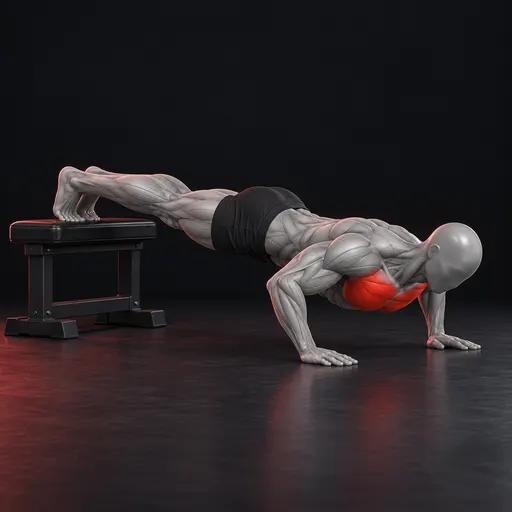
Decline Push-up is a bodyweight – closed-chain press exercise involving Pectoralis major, Triceps brachii. Use these steps to learn the movement and work with your coach to choose a suitable level.
Last updated: · DynPerformance
- Primary muscles
- Pectoralis major, Triceps brachii
- Secondary muscles
- Anterior deltoid, Serratus anterior, Rectus abdominis, Gluteus maximus
- Exercise type
- Bodyweight – closed-chain press
Exercise technique
- Platform
Place your toes on a low, stable bench.
- Hands
Set your palms slightly wider than shoulder width on the floor, distributing pressure evenly through the finger bases.
- Alignment
Form a straight line through legs and torso while maintaining abdominal and glute tension.
- Lowering path
Bend your elbows diagonally backward and lower your chest toward the floor.
- Shoulder control
Pause briefly within a comfortable shoulder range without reaching your head forward.
- Press
Exhale and push the floor away, raising your body together with your feet fixed on the platform.
- Repeat
Extend your arms under control and check the plank line; lower the foot height if needed.
Key technique points
- Use a non-slip foot platform.
- Do not increase your lower-back arch.
- Keep your head in line with your torso.
- Load both palms evenly.
- Lower your chest under control.
- Adjust height according to shoulder control.
Common mistakes
Raising the platform too soon
Do not use a height where you cannot control the descent; lower your feet and rebuild a solid plank.
Sagging lower back
Do not let your abdomen drop as foot height increases; maintain abdominal and glute tension together.
Reaching the neck toward the floor
Do not lower your forehead before your chest or gain depth through neck movement.
Slipping feet
Do not hang your toes insecurely on the bench edge; provide firm contact for both feet.
Flaring the elbows
Do not force your upper arms sideways at shoulder level; use a diagonal bend comfortable for your shoulders.
Pushing the hips up
Do not enter a pike position at the difficult point; maintain the push-up’s head-to-heel line.
Frequently asked questions
Decline Push-up: why is “Raising the platform too soon” a mistake?
Do not use a height where you cannot control the descent; lower your feet and rebuild a solid plank.
Decline Push-up: why is “Sagging lower back” a mistake?
Do not let your abdomen drop as foot height increases; maintain abdominal and glute tension together.
Decline Push-up: why is “Reaching the neck toward the floor” a mistake?
Do not lower your forehead before your chest or gain depth through neck movement.
Decline Push-up: why is “Slipping feet” a mistake?
Do not hang your toes insecurely on the bench edge; provide firm contact for both feet.
Decline Push-up: why is “Flaring the elbows” a mistake?
Do not force your upper arms sideways at shoulder level; use a diagonal bend comfortable for your shoulders.
Decline Push-up: why is “Pushing the hips up” a mistake?
Do not enter a pike position at the difficult point; maintain the push-up’s head-to-heel line.
What should I focus on when doing Decline Push-up?
Use a non-slip foot platform. Do not increase your lower-back arch. Keep your head in line with your torso. Load both palms evenly. Lower your chest under control. Adjust height according to shoulder control.
Related exercises
Add this exercise to your program with your coach
If you have a health condition, consult a qualified professional.