Dumbbell Fly
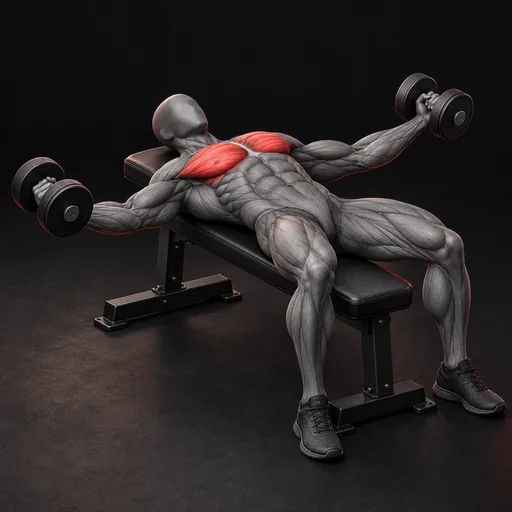
Dumbbell Fly is a resistance exercise – shoulder horizontal adduction exercise involving Pectoralis major. Use these steps to learn the movement and work with your coach to choose a suitable level.
Last updated: · DynPerformance
- Primary muscles
- Pectoralis major
- Secondary muscles
- Anterior deltoid, Serratus anterior, Biceps brachii (stabilization)
- Exercise type
- Resistance exercise – shoulder horizontal adduction
Exercise technique
- Lie down
Use thigh support to bring the dumbbells above your chest as you lie on a flat bench.
- Support
Plant your feet and keep your head, shoulder blades and hips on the pad.
- Start
Face your palms toward each other and bend your elbows slightly.
- Open the arc
Inhale and open your arms sideways at chest level without changing elbow angle.
- Bottom control
Stop at your shoulders’ comfortable range; do not shift the weights toward your head.
- Close
Use your chest to bring your arms upward along the same broad arc, exhaling.
- Top balance
Bring the dumbbells close without contact and repeat with elbows still slightly bent.
Key technique points
- Maintain a fixed elbow bend.
- Open your arms in the chest plane.
- Do not let your shoulders drift forward at the bottom.
- Use equal ranges on both sides.
- Choose light, controllable weights.
- Do not hit the weights together at the top.
Common mistakes
Turning the fly into a press
Do not increasingly bend your elbows on descent and straighten them on ascent; keep arm length constant through the shoulder arc.
Opening too low
Do not lower the dumbbells far below the pad; return before losing anterior-shoulder control.
Locking the elbows
Do not carry the long lever with locked elbows; maintain a small, fixed bend.
Drifting toward the head
Do not move your arms from beside your chest toward the back of your head; maintain the chest-level plane.
Unequal arcs
Do not let one arm fall lower; match both shoulders’ comfortable ranges.
Colliding at the top
Do not seek contraction by hitting the dumbbells together; pause where they converge under control.
Frequently asked questions
Dumbbell Fly: why is “Turning the fly into a press” a mistake?
Do not increasingly bend your elbows on descent and straighten them on ascent; keep arm length constant through the shoulder arc.
Dumbbell Fly: why is “Opening too low” a mistake?
Do not lower the dumbbells far below the pad; return before losing anterior-shoulder control.
Dumbbell Fly: why is “Locking the elbows” a mistake?
Do not carry the long lever with locked elbows; maintain a small, fixed bend.
Dumbbell Fly: why is “Drifting toward the head” a mistake?
Do not move your arms from beside your chest toward the back of your head; maintain the chest-level plane.
Dumbbell Fly: why is “Unequal arcs” a mistake?
Do not let one arm fall lower; match both shoulders’ comfortable ranges.
Dumbbell Fly: why is “Colliding at the top” a mistake?
Do not seek contraction by hitting the dumbbells together; pause where they converge under control.
What should I focus on when doing Dumbbell Fly?
Maintain a fixed elbow bend. Open your arms in the chest plane. Do not let your shoulders drift forward at the bottom. Use equal ranges on both sides. Choose light, controllable weights. Do not hit the weights together at the top.
Related exercises
Add this exercise to your program with your coach
If you have a health condition, consult a qualified professional.