Dumbbell Pullover
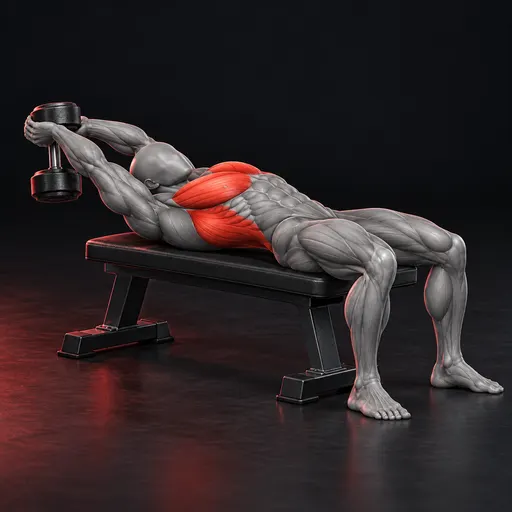
Dumbbell Pullover is a resistance exercise – shoulder extension exercise involving Latissimus dorsi, Pectoralis major. Use these steps to learn the movement and work with your coach to choose a suitable level.
Last updated: · DynPerformance
- Primary muscles
- Latissimus dorsi, Pectoralis major
- Secondary muscles
- Triceps brachii long head, Serratus anterior, Rectus abdominis
- Exercise type
- Resistance exercise – shoulder extension
Exercise technique
- Check the dumbbell
Choose a fixed-head dumbbell and support beneath the upper head with both palms.
- Lie on the bench
Lie with your head and back supported and feet planted.
- Top start
Hold the dumbbell above your chest with a small elbow bend.
- Rib position
Brace your abdomen without unnecessarily increasing your lower-back arch, allowing movement at the shoulders.
- Backward arc
Inhale and lower the dumbbell behind your head while maintaining elbow angle.
- Comfortable limit
Stop at the limit of shoulder range; do not lift your chest to reach farther back.
- Return forward
Exhale and bring the weight over your chest along the same arc, balancing at the top.
Key technique points
- Use a fixed dumbbell head.
- Support your head and back.
- Maintain elbow angle.
- Do not flare your ribs.
- Limit behind-head travel to a comfortable range.
- Do not relax your grip over your face.
Common mistakes
Holding a loose head
Do not use a dumbbell with moving plates or heads overhead; choose one you can support securely with both palms.
Arching the lower back
Do not flare your ribs toward the ceiling as the weight moves back; do not substitute lower-back extension for shoulder range.
Moving through the elbows
Do not bend your elbows deeply on descent and straighten them at the top; preserve the shoulder arc instead of performing a triceps extension.
Reaching too far back
Do not force the dumbbell farther behind your head after losing shoulder control; reverse within a comfortable range.
Reversing quickly
Do not swing the weight from the bottom over your chest; control the speed of the long lever.
Drifting over the face
Do not let the dumbbell fall toward your face at the top; pause with balanced hand-wrist alignment over your chest.
Frequently asked questions
Dumbbell Pullover: why is “Holding a loose head” a mistake?
Do not use a dumbbell with moving plates or heads overhead; choose one you can support securely with both palms.
Dumbbell Pullover: why is “Arching the lower back” a mistake?
Do not flare your ribs toward the ceiling as the weight moves back; do not substitute lower-back extension for shoulder range.
Dumbbell Pullover: why is “Moving through the elbows” a mistake?
Do not bend your elbows deeply on descent and straighten them at the top; preserve the shoulder arc instead of performing a triceps extension.
Dumbbell Pullover: why is “Reaching too far back” a mistake?
Do not force the dumbbell farther behind your head after losing shoulder control; reverse within a comfortable range.
Dumbbell Pullover: why is “Reversing quickly” a mistake?
Do not swing the weight from the bottom over your chest; control the speed of the long lever.
Dumbbell Pullover: why is “Drifting over the face” a mistake?
Do not let the dumbbell fall toward your face at the top; pause with balanced hand-wrist alignment over your chest.
What should I focus on when doing Dumbbell Pullover?
Use a fixed dumbbell head. Support your head and back. Maintain elbow angle. Do not flare your ribs. Limit behind-head travel to a comfortable range. Do not relax your grip over your face.
Related exercises
- Machine-assisted Pull-up
- Resistance Band Chest Press
- Resistance Band Row
- Barbell Row
- Bench Press
- Exercise Guide
Add this exercise to your program with your coach
If you have a health condition, consult a qualified professional.