Lateral Raise
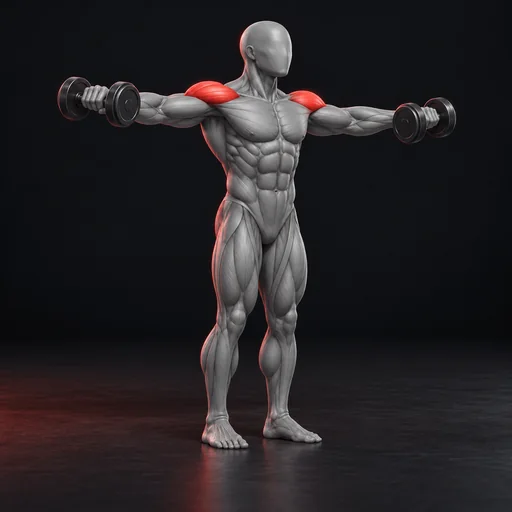
Lateral Raise is a resistance exercise - shoulder abduction exercise involving Middle deltoid. Use these steps to learn the movement and work with your coach to choose a suitable level.
Last updated: · DynPerformance
- Primary muscles
- Middle deltoid
- Secondary muscles
- Supraspinatus, Serratus anterior, Upper trapezius, Anterior deltoid
- Exercise type
- Resistance exercise - shoulder abduction
Exercise technique
- Start
Stand at a comfortable width and hold light dumbbells at your sides.
- Arm position
Bend your elbows slightly and keep your wrists aligned with your forearms.
- Plane
Choose a comfortable shoulder plane by directing your arms slightly forward of directly sideways.
- Raise
Exhale and raise your upper arms sideways without momentum from your knees or hips.
- Upper limit
Pause briefly when your elbows reach shoulder height; do not throw your hands higher.
- Lower
Slowly return the dumbbells to your sides along the same arc without hitting your thighs.
- Reset
Keep your torso stable at the bottom and begin the next repetition without swinging.
Key technique points
- Control the long lever with a light load.
- Monitor upper-arm height.
- Do not force your thumbs downward.
- Do not pull your shoulders toward your ears.
- Do not use your knees as springs.
- Lower as slowly as you lift.
Common mistakes
Swinging the torso
Do not launch the dumbbells with your hips; raise your arms with control instead of using momentum that reduces lateral-shoulder loading.
Shrugging
Do not squeeze your shoulders toward your ears as your arms rise; focus on lateral upper-arm movement.
Turning the thumbs down
Do not forcibly rotate your wrists as if pouring water; maintain comfortable shoulder rotation.
Changing elbow angle
Do not bend your arms progressively during the lift; keep the selected slight bend and moment arm consistent.
Raising too high
Do not swing your arms to exceed shoulder level; set the top at a comfortable upper-arm height.
Releasing the descent
Do not drop the dumbbells onto your thighs; brake the descent with your shoulder muscles and return along the same arc.
Frequently asked questions
Lateral Raise: why is “Swinging the torso” a mistake?
Do not launch the dumbbells with your hips; raise your arms with control instead of using momentum that reduces lateral-shoulder loading.
Lateral Raise: why is “Shrugging” a mistake?
Do not squeeze your shoulders toward your ears as your arms rise; focus on lateral upper-arm movement.
Lateral Raise: why is “Turning the thumbs down” a mistake?
Do not forcibly rotate your wrists as if pouring water; maintain comfortable shoulder rotation.
Lateral Raise: why is “Changing elbow angle” a mistake?
Do not bend your arms progressively during the lift; keep the selected slight bend and moment arm consistent.
Lateral Raise: why is “Raising too high” a mistake?
Do not swing your arms to exceed shoulder level; set the top at a comfortable upper-arm height.
Lateral Raise: why is “Releasing the descent” a mistake?
Do not drop the dumbbells onto your thighs; brake the descent with your shoulder muscles and return along the same arc.
What should I focus on when doing Lateral Raise?
Control the long lever with a light load. Monitor upper-arm height. Do not force your thumbs downward. Do not pull your shoulders toward your ears. Do not use your knees as springs. Lower as slowly as you lift.
Related exercises
- Kettlebell Arnold Press
- Kettlebell Seated Press
- Kettlebell Seesaw Press
- Lateral Raise - With Bands
- Leverage Shoulder Press
- Exercise Guide
Add this exercise to your program with your coach
If you have a health condition, consult a qualified professional.