Bent-over Dumbbell Reverse Fly
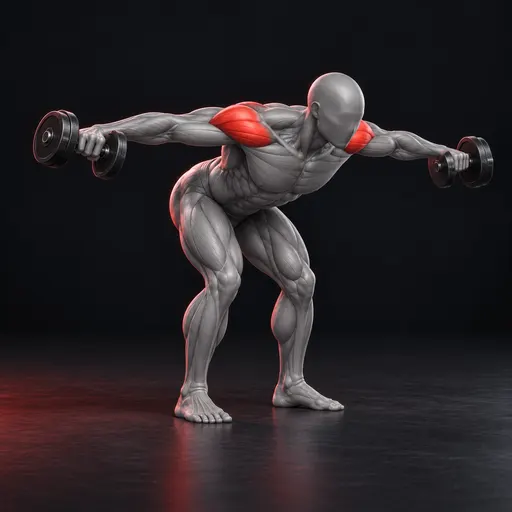
Bent-over Dumbbell Reverse Fly is a resistance exercise - rear-shoulder horizontal abduction exercise involving Posterior deltoid. Use these steps to learn the movement and work with your coach to choose a suitable level.
Last updated: · DynPerformance
- Primary muscles
- Posterior deltoid
- Secondary muscles
- Middle trapezius, Rhomboids, Infraspinatus, Teres minor
- Exercise type
- Resistance exercise - rear-shoulder horizontal abduction
Exercise technique
- Hip hinge
Slightly bend your knees and send your hips backward to lean your torso forward.
- Back line
Keep your neck aligned with your back and your chest naturally directed toward the floor.
- Starting load
Let the dumbbells hang beneath your chest with your palms facing each other.
- Elbows
Maintain a small, fixed bend in both elbows.
- Open sideways
Exhale as you raise your arms to the sides until your upper arms are approximately in the same plane as your torso.
- Top control
Pause briefly without raising your shoulders toward your ears or straightening your torso.
- Lower
Slowly bring your arms beneath your chest and repeat at the same torso angle.
Key technique points
- Hinge at the hips and keep your back natural.
- Do not throw your neck backward.
- Maintain arm length during the bent-over fly.
- Open your arms sideways.
- Maintain torso height.
- Do not drop the dumbbells downward.
Common mistakes
Rounding the back
Do not create the forward lean by collapsing your lower back and neck; stabilize your torso through a hip hinge.
Straightening on every repetition
Do not throw your chest upward to lift the dumbbells and reduce rear-shoulder work through torso momentum.
Turning it into a row
Do not bend your elbows substantially and pull the dumbbells toward your ribs; maintain lateral arm opening.
Driving the arms backward
Do not move the dumbbells toward your hips; direct your upper arms sideways for the rear shoulders.
Raising the shoulders
Do not pull your shoulders toward your ears as your arms open; maintain a long neck and scapular control.
Dropping downward
Do not release the weights beneath your chest; control both arms evenly and slowly on the descent.
Frequently asked questions
Bent-over Dumbbell Reverse Fly: why is “Rounding the back” a mistake?
Do not create the forward lean by collapsing your lower back and neck; stabilize your torso through a hip hinge.
Bent-over Dumbbell Reverse Fly: why is “Straightening on every repetition” a mistake?
Do not throw your chest upward to lift the dumbbells and reduce rear-shoulder work through torso momentum.
Bent-over Dumbbell Reverse Fly: why is “Turning it into a row” a mistake?
Do not bend your elbows substantially and pull the dumbbells toward your ribs; maintain lateral arm opening.
Bent-over Dumbbell Reverse Fly: why is “Driving the arms backward” a mistake?
Do not move the dumbbells toward your hips; direct your upper arms sideways for the rear shoulders.
Bent-over Dumbbell Reverse Fly: why is “Raising the shoulders” a mistake?
Do not pull your shoulders toward your ears as your arms open; maintain a long neck and scapular control.
Bent-over Dumbbell Reverse Fly: why is “Dropping downward” a mistake?
Do not release the weights beneath your chest; control both arms evenly and slowly on the descent.
What should I focus on when doing Bent-over Dumbbell Reverse Fly?
Hinge at the hips and keep your back natural. Do not throw your neck backward. Maintain arm length during the bent-over fly. Open your arms sideways. Maintain torso height. Do not drop the dumbbells downward.
Related exercises
- Band Pull-apart
- Cross-body Shoulder Stretch
- Cable Face Pull
- Back Flyes - With Bands
- Barbell Rear Delt Row
- Exercise Guide
Add this exercise to your program with your coach
If you have a health condition, consult a qualified professional.