Suspension Push-up
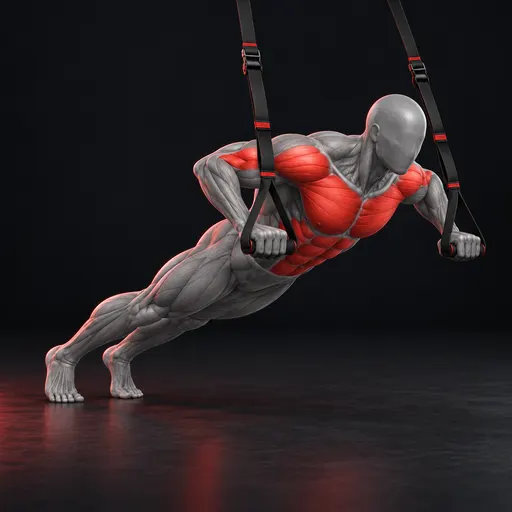
Suspension Push-up is a bodyweight – closed-chain push exercise involving Pectoralis major, Triceps brachii. Use these steps to learn the movement and work with your coach to choose a suitable level.
Last updated: · DynPerformance
- Primary muscles
- Pectoralis major, Triceps brachii
- Secondary muscles
- Anterior deltoid, Serratus anterior, Rectus abdominis, Gluteus maximus
- Exercise type
- Bodyweight – closed-chain push
Exercise technique
- Check the straps
Verify that the anchor is secure and both straps are equally long.
- Handles
Grip the handles securely and align your wrists with your forearms.
- Choose an angle
Step your feet back and lean forward, starting at an inclined plank angle you can control.
- Torso
Brace your abdomen and glutes to keep a straight line from head to heels.
- Lower
Bend your elbows to bring your chest between the handles without letting the straps drift sideways.
- Push
Exhale and press into the handles to extend your arms, raising your torso as one unit.
- Balance at the top
Briefly regain control as the straps stop swinging; keep the same body angle on the next repetition.
Key technique points
- Make the straps equal in length.
- Keep your wrists neutral.
- Choose an angle suited to your balance.
- Track the handles beside your chest.
- Do not let your abdomen sag.
- Do not use the straps to support your upper arms.
Common mistakes
Unequal straps
Do not leave one handle lower than the other; both sides of your chest and shoulders should start with equal support.
Letting the handles spread sideways
Do not let your hands drift apart uncontrollably on the descent; use a width at which you can manage the increased shoulder demand.
Sagging through the lower back
Do not let your abdomen drop as your chest lowers; meet the balance demand with abdominal and glute tension.
Starting too horizontally
Do not choose a difficult foot position that makes you unstable; first establish clean repetitions with a more upright torso.
Leaning against the straps
Do not rest your upper arms against the straps for balance; support the load through your handle grip.
Rotating the torso
Do not press more through one arm and turn your hips sideways; keep both hands pushing at the same speed with even foot support.
Frequently asked questions
Suspension Push-up: why is “Unequal straps” a mistake?
Do not leave one handle lower than the other; both sides of your chest and shoulders should start with equal support.
Suspension Push-up: why is “Letting the handles spread sideways” a mistake?
Do not let your hands drift apart uncontrollably on the descent; use a width at which you can manage the increased shoulder demand.
Suspension Push-up: why is “Sagging through the lower back” a mistake?
Do not let your abdomen drop as your chest lowers; meet the balance demand with abdominal and glute tension.
Suspension Push-up: why is “Starting too horizontally” a mistake?
Do not choose a difficult foot position that makes you unstable; first establish clean repetitions with a more upright torso.
Suspension Push-up: why is “Leaning against the straps” a mistake?
Do not rest your upper arms against the straps for balance; support the load through your handle grip.
Suspension Push-up: why is “Rotating the torso” a mistake?
Do not press more through one arm and turn your hips sideways; keep both hands pushing at the same speed with even foot support.
What should I focus on when doing Suspension Push-up?
Make the straps equal in length. Keep your wrists neutral. Choose an angle suited to your balance. Track the handles beside your chest. Do not let your abdomen sag. Do not use the straps to support your upper arms.
Related exercises
Add this exercise to your program with your coach
If you have a health condition, consult a qualified professional.