Seated Dumbbell Wrist Curl
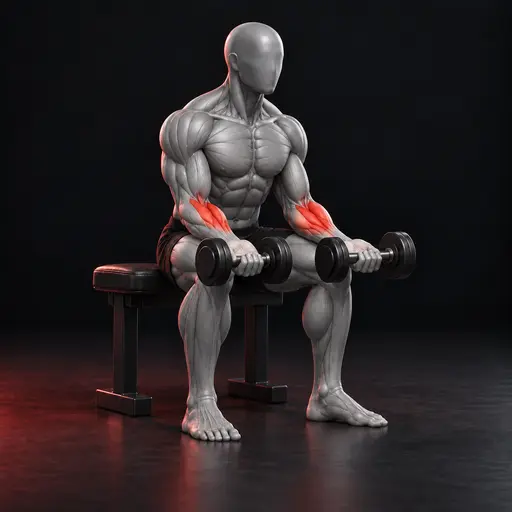
Seated Dumbbell Wrist Curl is a resistance exercise – isolated wrist movement exercise involving Forearm flexors. Use these steps to learn the movement and work with your coach to choose a suitable level.
Last updated: · DynPerformance
- Primary muscles
- Forearm flexors
- Secondary muscles
- Finger flexors, Brachioradialis (stabilization)
- Exercise type
- Resistance exercise – isolated wrist movement
Exercise technique
- Sit
Sit at the end of a bench with your feet planted and knees comfortably apart.
- Forearm support
Rest your forearms on your thighs with your palms facing upward.
- Wrist space
Let your hands extend beyond your knees so your wrists can bend freely.
- Grip
Keep a closed grip on the dumbbell handles without rolling them into your fingers.
- Curl
Exhale and draw your palms toward your forearms to raise the dumbbells.
- Top pause
Keep your forearms on your thighs and pause at the small contraction point.
- Extend
Slowly lower your wrists to a comfortable bottom limit without lifting your elbows.
Key technique points
- Keep your palms facing upward.
- Stabilize your forearms on your thighs.
- Let your wrists extend past the edge.
- Do not release the dumbbells into your fingers.
- Curl along a straight axis without tilting sideways.
- Control the small range of motion.
Common mistakes
Lifting the forearms
Do not lift your elbows from your thighs to raise the dumbbells; keep movement at the wrist joint only.
Rolling onto the fingers
In this variation, do not let the dumbbells roll to your fingertips; maintain a closed grip without increasing the risk of slipping.
Tilting the wrists sideways
Do not bend toward the little-finger or thumb side; flex the palm along a straight axis.
Using excessive lower range
Do not keep descending as the weight forces your wrist backward; reverse at a comfortable limit before active control ends.
Bouncing
Do not raise the dumbbell with a rapid wrist bounce; use a slow, even rhythm for this small joint movement.
Incorrect support placement
Do not try to curl while your hand is trapped over your knee; keep the forearm supported and the wrist free at the edge.
Frequently asked questions
Seated Dumbbell Wrist Curl: why is “Lifting the forearms” a mistake?
Do not lift your elbows from your thighs to raise the dumbbells; keep movement at the wrist joint only.
Seated Dumbbell Wrist Curl: why is “Rolling onto the fingers” a mistake?
In this variation, do not let the dumbbells roll to your fingertips; maintain a closed grip without increasing the risk of slipping.
Seated Dumbbell Wrist Curl: why is “Tilting the wrists sideways” a mistake?
Do not bend toward the little-finger or thumb side; flex the palm along a straight axis.
Seated Dumbbell Wrist Curl: why is “Using excessive lower range” a mistake?
Do not keep descending as the weight forces your wrist backward; reverse at a comfortable limit before active control ends.
Seated Dumbbell Wrist Curl: why is “Bouncing” a mistake?
Do not raise the dumbbell with a rapid wrist bounce; use a slow, even rhythm for this small joint movement.
Seated Dumbbell Wrist Curl: why is “Incorrect support placement” a mistake?
Do not try to curl while your hand is trapped over your knee; keep the forearm supported and the wrist free at the edge.
What should I focus on when doing Seated Dumbbell Wrist Curl?
Keep your palms facing upward. Stabilize your forearms on your thighs. Let your wrists extend past the edge. Do not release the dumbbells into your fingers. Curl along a straight axis without tilting sideways. Control the small range of motion.
Related exercises
- Cable Wrist Curl
- Seated Dumbbell Palms-Up Wrist Curl
- Seated One-Arm Dumbbell Palms-Up Wrist Curl
- Seated Palm-Up Barbell Wrist Curl
- Seated Two-Arm Palms-Up Low-Pulley Wrist Curl
- Exercise Guide
Add this exercise to your program with your coach
If you have a health condition, consult a qualified professional.