Side-lying Clamshell
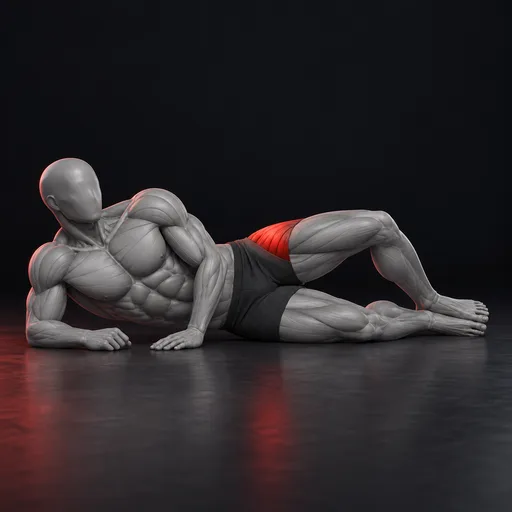
Side-lying Clamshell is a strength – resistance exercise exercise involving Gluteus medius, Hip external rotators. Use these steps to learn the movement and work with your coach to choose a suitable level.
Last updated: · DynPerformance
- Primary muscles
- Gluteus medius, Hip external rotators
- Secondary muscles
- Gluteus maximus, Lateral abdominal wall
- Exercise type
- Strength – resistance exercise
Exercise technique
- Side-lying position
Support your head and stack your hips.
- Knee angle
Bend both knees and keep your feet together.
- Pelvis
Stabilize your top hip without letting it roll backward.
- Open
Lift your top knee while keeping your heels together.
- Pause
Stop before your pelvis begins to rotate.
- Close
Slowly bring your top knee toward the lower knee.
- Switch
Turn to the other side while preserving body alignment.
Key technique points
- Keep your heels together.
- Do not roll the top hip backward.
- Do not twist your lower back to open the knee.
- Keep your shoulders stacked.
- Choose a small, controlled range.
- Do not knock your knees together as you close.
Common mistakes
Rolling backward
The knee opening comes from torso rotation instead of hip rotation.
Separating the feet
This loses the fixed heel connection of the clamshell.
Twisting the lower back
This reduces pelvic stability.
Opening too far
The torso moves once you exceed your control limit.
Throwing the shoulder backward
Upper-body movement rotates the hips too.
Closing quickly
This removes the external rotators’ control of the return.
Frequently asked questions
Side-lying Clamshell: why is “Rolling backward” a mistake?
The knee opening comes from torso rotation instead of hip rotation.
Side-lying Clamshell: why is “Separating the feet” a mistake?
This loses the fixed heel connection of the clamshell.
Side-lying Clamshell: why is “Twisting the lower back” a mistake?
This reduces pelvic stability.
Side-lying Clamshell: why is “Opening too far” a mistake?
The torso moves once you exceed your control limit.
Side-lying Clamshell: why is “Throwing the shoulder backward” a mistake?
Upper-body movement rotates the hips too.
Side-lying Clamshell: why is “Closing quickly” a mistake?
This removes the external rotators’ control of the return.
What should I focus on when doing Side-lying Clamshell?
Keep your heels together. Do not roll the top hip backward. Do not twist your lower back to open the knee. Keep your shoulders stacked. Choose a small, controlled range. Do not knock your knees together as you close.
Related exercises
- 45-degree Back Extension
- Back Squat
- Banded Lateral Walk
- Barbell Hip Thrust
- Bodyweight Forward Lunge
- Exercise Guide
Add this exercise to your program with your coach
If you have a health condition, consult a qualified professional.