Single-leg Glute Bridge
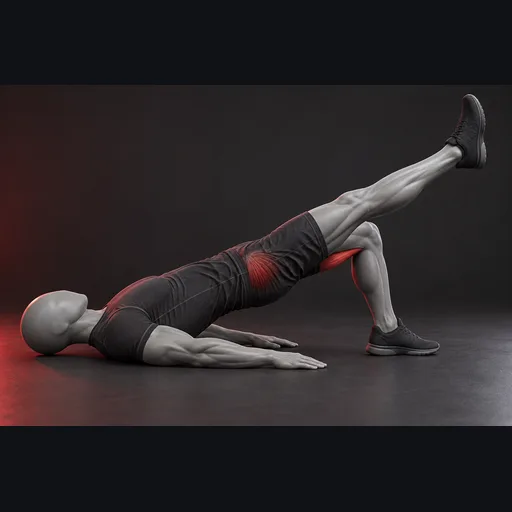
Single-leg Glute Bridge is a resistance exercise – strength exercise involving Gluteus maximus. Use these steps to learn the movement and work with your coach to choose a suitable level.
Last updated: · DynPerformance
- Primary muscles
- Gluteus maximus
- Secondary muscles
- Hamstring, Gluteus medius, Abdominals
- Exercise type
- Resistance exercise – strength
Exercise technique
- Start
Lie on your back with both knees bent.
- Working foot
Secure one sole near your hips.
- Free leg
Lift the other knee toward your torso.
- Level pelvis
Keep both hip bones at equal height.
- Rise
Push through the planted foot to lift your hips.
- Top
Align your shoulder, hip and supporting knee.
- Lower
Lower your pelvis without putting the free leg down.
Key technique points
- Do not gain momentum by swinging your free knee.
- Do not turn your supporting foot sideways.
- Do not rotate your pelvis toward the working side.
- Keep both hips at equal height.
- Rest your neck comfortably on the floor.
- Rise without increasing the lower-back arch.
Common mistakes
Pelvis dropping
Single-hip balance is lost when the free-leg side drops.
Knee swing
The free leg generates momentum.
Heel shifting
Support distance changes during the repetition.
Turning through the shoulder
The torso loads to one side.
Rising too high
Lower-back movement replaces hip extension.
Planting the free foot
Single-leg loading is interrupted.
Frequently asked questions
Single-leg Glute Bridge: why is “Pelvis dropping” a mistake?
Single-hip balance is lost when the free-leg side drops.
Single-leg Glute Bridge: why is “Knee swing” a mistake?
The free leg generates momentum.
Single-leg Glute Bridge: why is “Heel shifting” a mistake?
Support distance changes during the repetition.
Single-leg Glute Bridge: why is “Turning through the shoulder” a mistake?
The torso loads to one side.
Single-leg Glute Bridge: why is “Rising too high” a mistake?
Lower-back movement replaces hip extension.
Single-leg Glute Bridge: why is “Planting the free foot” a mistake?
Single-leg loading is interrupted.
What should I focus on when doing Single-leg Glute Bridge?
Do not gain momentum by swinging your free knee. Do not turn your supporting foot sideways. Do not rotate your pelvis toward the working side. Keep both hips at equal height. Rest your neck comfortably on the floor. Rise without increasing the lower-back arch.
Related exercises
Add this exercise to your program with your coach
If you have a health condition, consult a qualified professional.